Unraveling Watercolor Paper a Beginner Guide
Table of Contents
I independently review every product I recommend. When you make a purchase through a link, I may earn a small commission at no additional cost to you. Learn more
Watercolor Paper: The Most Important Tool for Watercolor Painting
Watercolor paper is the canvas for your imagination, the cornerstone upon which your artistic dreams take shape. Its significance in the world of painting cannot be overstated. Beyond merely holding paint, the paper itself plays a crucial role in the final outcome of a watercolor piece.
While I am painting I cherish the way watercolor paint interacts with the paper’s texture, whether it’s the gentle absorption of colors into its fibers or the subtle granulation that adds character to the artwork. The paper you choose can significantly influence the overall look, feel, and mood of a painting.
Selecting the right watercolor paper goes beyond mere aesthetics. It affects how the paint behaves, how colors blend, and even the level of detail that can be achieved. A high-quality paper can absorb water and pigment evenly, giving artists greater control over their work.
The relationship between the painter and the paper is a dance, a collaboration where each step influences the other. A good understanding of various types of watercolor paper, their textures, weights, and sizing can empower artists to harness their creativity more effectively.
Choosing the perfect paper is akin to finding the right partner in a dance. It allows artists to showcase their skills while providing the support they need to create beautiful, harmonious art. The journey of a watercolor painting starts with this crucial decision: selecting the ideal watercolor paper.
Let me be your guide as we explore the different types of watercolor paper, delve into their unique attributes, sizing techniques, the best brands available in the market, and a wealth of information to aid in making informed choices. Your journey to masterful watercolor creations begins here, with the foundation, the paper.
Types of Watercolor Paper
Watercolor paper comes in different varieties, each offering unique characteristics that influence the painting process and the final artwork. Understanding these variations is fundamental to selecting the most suitable paper for your creative endeavors.
Cold Pressed
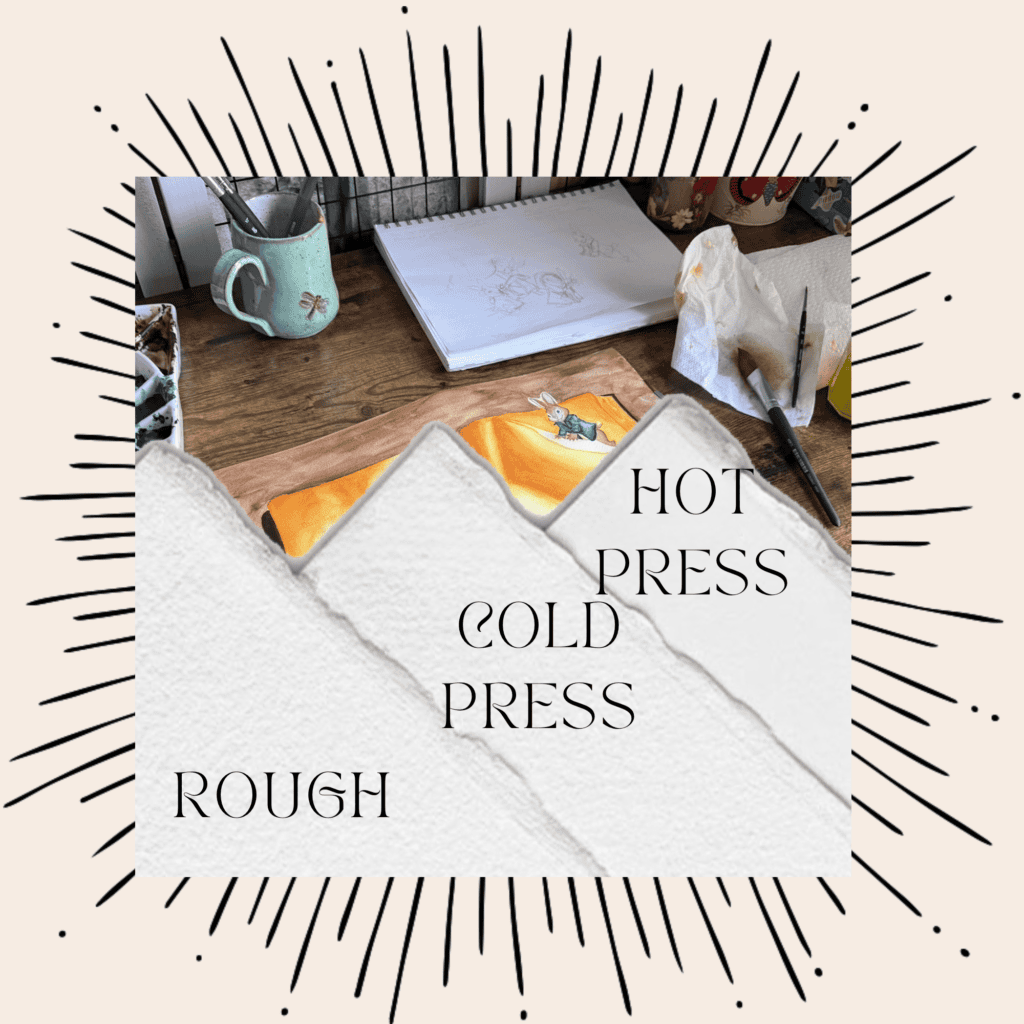
Cold-pressed watercolor paper is a popular choice among artists. Its surface texture falls between that of hot-pressed and rough paper. The texture is slightly bumpy, providing some tooth, which allows for good pigment absorption while offering enough smoothness for controlled brushwork. It’s versatile, and suitable for both detailed work and washes. Cold-pressed watercolor paper strikes the perfect balance between texture and smoothness, making it a go-to choice for various painting styles. Cold-pressed watercolor paper is the main paper I use in my artistic endeavors. I highly recommend this type and texture!
Hot Pressed
Hot-pressed watercolor paper has a smooth surface, ideal for intricate details and precise brushwork. The absence of texture allows for sharper lines and controlled color application. It doesn’t absorb water as readily as cold-pressed paper, allowing more time for color manipulation before drying. Artists fond of detailed illustrations, botanical paintings, and works requiring fine lines often prefer this type of paper. Because hot-pressed watercolor paper isn’t as quick to absorb the pigments, sometimes the color tends to float on top of the paper. It’s different for different brands, so don’t be afraid to try different hot-pressed watercolor paper brands before you make a judgment.
Rough
Rough watercolor paper boasts the most textured surface among the different types. The pronounced bumps and irregularities create fascinating textures in paintings. The granulated effect produced by rough paper can add depth and character to artwork, especially landscapes, and pieces where texture plays a significant role. If you are an artist looking to incorporate expressive brushwork and organic textures into your paintings then rough watercolor paper might be your best bet!
Each type of watercolor paper offers a distinct painting experience, and selecting the right one depends on the desired artistic outcome and personal preferences. Experimentation with various types can reveal new possibilities, guiding artists toward discovering their preferred paper for different projects.
Understanding Paper Sizing
In the realm of watercolor paper, sizing is a critical element that significantly influences how the paper interacts with water and paint. Sizing refers to the material added to the paper during its production, affecting its absorbency and handling of paint.
Explanation of Sizing in Watercolor Paper
Sizing acts as a protective layer on the paper’s surface, typically made of gelatin or synthetic substances. It prevents the paint from immediately sinking into the fibers, allowing artists more control over their brushwork and paint application. Without proper sizing, the paper would quickly absorb water and pigment, making it challenging to achieve the desired effects.
Significance in Painting and Paper Behavior
The presence and quality of sizing impact how watercolor paint behaves on the paper. Well-sized watercolor paper enables artists to work with wet-on-wet techniques, glazing, and lifting colors without damaging the paper’s surface or compromising its structural integrity. Properly sized watercolor paper allows for corrections and adjustments while maintaining vibrancy in the colors.
Understanding the paper’s sizing, whether internal (within the paper fibers) or surface sizing, is essential for artists to choose the right paper suitable for their techniques and preferred painting styles.
Top Professional Watercolor Paper Brands
When seeking premium quality in watercolor paper, several standout brands consistently deliver excellence, offering artists unparalleled surfaces for their creations.
Below are 5 recommendations for professional watercolor paper. I am not an affiliate of any of these paper brands. If you decide to make a purchase through an Amazon link I will receive a small commission at no additional cost to you. Learn more
Arches
Arches (pronounced arsh) remains an esteemed choice, revered for its consistently high quality, durability, and adaptability. Crafted from cotton fibers, Arches paper boasts exceptional absorbency, ideal for achieving vivid colors and smooth washes. Arches watercolor paper takes pride in its exclusive technique of sizing its paper completely to the core. Its sturdiness allows for multi-layer painting without compromising the paper’s integrity, making it a top pick for artists across various genres. Arches has become my favorite watercolor paper to paint on!
Amazon Link to Arches Watercolor Paper
Saunders Waterford
Saunders Waterford, prized for its exquisite balance between texture and durability, is a preferred choice among artists. With a focus on high-quality cotton and sizing, it offers a diverse range of paper surfaces, catering to the needs of artists seeking precision and versatility in their work. I enjoy painting on Saunders Waterford as well.
Amazon Link to Saunders Waterford Paper
Winsor & Newton
Winsor & Newton, a name synonymous with art supplies, delivers a line of professional watercolor papers known for their reliable quality and surface consistency. Available in various textures, weights, and sizes, their papers accommodate the needs of artists, from intricate detailing to broad washes.
Amazon Link to Windsor & Newton Watercolor Paper
Fabriano
Fabriano Artistico, with its long-standing tradition and commitment to quality, stands as another cornerstone in professional watercolor paper. Known for its versatile range of surfaces and weights, Fabriano offers artists a variety of options to suit their specific styles, from cold-pressed textures to extra-smooth hot-pressed sheets.
Amazon Link to Fabriano Artistico Watercolor Paper
Hahnemühle
Hahnemühle is a trusted name in fine art paper and offers a selection of professional watercolor surfaces known for their archival quality and diverse textures. With a focus on innovation and longevity( since 1584), Hahnemühle papers are a preferred choice for artists seeking both traditional and experimental approaches in watercolor painting.
Amazon Link to Hahnemühle Watercolor Paper
Best Student-Grade Watercolor Paper Brands
For artists starting their creative journey or seeking more budget-friendly options, several brands offer quality student-grade watercolor papers, providing a balance between performance and affordability.
Below are 5 recommendations for student-grade watercolor paper. I am not an affiliate of any of these paper brands. If you decide to make a purchase through an Amazon link I will receive a small commission at no additional cost to you. Learn more
Paul Rubens
Paul Rubens stands out among student-grade options, including your personal preference. Known for offering a balance between quality and cost-effectiveness, their papers provide adequate performance for beginners and students. While being more budget-friendly, Paul Rubens paper maintains decent durability and good absorbency, making it suitable for practicing different techniques without breaking the bank. I often use Paul Rubens’ blocks when trying out new techniques.
Amazon Link to Paul Rubens Watercolor Paper
Strathmore
Strathmore offers a diverse range of student-grade watercolor papers, catering to various skill levels. Their papers come in different textures and weights, providing options for artists exploring different techniques. With a focus on affordability and reasonable quality, Strathmore papers serve as an excellent choice for practice and learning.
Amazon Link to Strathmore Watercolor Paper
Canson
Everybody knows Canson. Remember that XL drawing pad you used to get from the art section of the grocery store? Canson provides another reliable option for student-grade watercolor paper. Known for its accessibility and suitability for beginners, Canson’s papers offer decent performance and come in various textures, making them suitable for experimentation and skill development without a significant investment.
Amazon Link to Canson XL Watercolor Paper
Winsor & Newton (Student Range)
Winsor & Newton offers student-grade watercolor papers that aim to provide a balance between cost and quality. Tailored for students and beginners, these papers maintain good performance standards, making them suitable for practice and learning without compromising on quality.
Amazon Link to Winsor & Newton Watercolor Paper
Daler Rowney
Daler Rowney offers student-grade papers known for their affordability and moderate quality. Suitable for beginners and those exploring different techniques, Daler Rowney Simply Watercolor Papers provide a cost-effective option for practicing and experimenting with watercolor.
Amazon Link to Daler Rowney Waterdcolor Paper
Watercolor Paper Formats: Blocks, Pads, Full Sheets, and Rolls
Selecting the right format for watercolor paper is crucial for artists and their creative process. Each format offers distinct advantages, catering to different preferences and painting styles. Here is a list of different formats of watercolor paper to help you in your decision-making process.
Watercolor Blocks
Watercolor blocks are a convenient and practical option for artists. These are bound on all sides, preventing the paper from warping when wet, and negating the need for stretching(A process of wetting and stretching out the paper then securing it to dry in hopes that it will not warp.)
The convenience of painting directly on a block eliminates the requirement for taping or mounting paper, allowing artists to focus solely on their art. Blocks are available in various sizes, offering portability and a stable surface ideal for plein air painting or working on the go.
Honestly, if you can afford to splurge for a block I highly recommend them! As a busy mom I find myself painting on my bed most of the time and watercolor paper blocks are the reason I can do it well!
Paper Pads
Watercolor paper pads offer individual sheets bound together, providing flexibility and ease of use. While pads lack the advantage of being pre-stretched like blocks, they are excellent for creating custom sketchbooks or experimenting with different techniques.
You can check out my guide on How to Create Your Own Watercolor Sketchbook with a Pad! Pads allow artists to easily tear out sheets for framing or displaying their work. They come in various sizes and are ideal for studio work or projects requiring multiple sheets of paper.
Full Sheets and Rolls
Full sheets and rolls of watercolor paper offer the most flexibility and versatility. Full sheets are perfect for larger, more extensive projects, enabling artists to cut the paper to their desired size. Rolls are excellent for artists who prefer working on continuous surfaces or need specific dimensions. These formats provide freedom and flexibility for artists to customize the size and shape of their work.
FAQs: Clarifying Watercolor Paper Queries
1. How do I determine the right weight or thickness of watercolor paper for my artwork?
The weight of watercolor paper is measured in pounds (lb) or grams per square meter (gsm). Lighter weights, such as 90 lb (190 gsm), are suitable for practice, studies, and sketching. For artworks requiring more layers, wet washes, or a sturdier surface, consider heavier weights, typically 140 lb (300 gsm) and above.
2. What does “cold-pressed” or “hot-pressed” watercolor paper mean?
Cold-pressed paper has a textured surface, while hot-pressed paper has a smoother finish. Cold-pressed is versatile, allowing for a range of techniques, while hot-pressed suits detailed work. The choice between the two depends on the desired texture and painting style.
3. How important is the texture of watercolor paper in a painting?
Extremely! Texture significantly influences the appearance and feel of a watercolor painting. Rough paper adds depth and character, ideal for landscapes or expressive work. Smooth surfaces, like hot-pressed paper, are excellent for intricate details and controlled brushwork.
4. Should I stretch the watercolor paper before painting?
Stretching watercolor paper, especially in loose sheet form, prevents warping caused by the absorption of water. While blocks don’t require stretching due to their pre-bound nature, stretching ensures a flat surface for better paint application.
5. How do I choose between cellulose and cotton fiber paper?
Cotton fiber paper is favored for its superior quality, durability, and ability to withstand multiple layers of paint. Cellulose paper is more economical and suitable for practice or experimentation. I use 100% cotton while my children ( who go through a lot of paper) use cellulose or a mix of cotton and cellulose.
6. What is the best way to store watercolor paper to maintain its quality?
Storing watercolor paper in a cool, dry place, away from direct sunlight and humidity, helps maintain its quality. Keep paper flat or in a vertical position to prevent warping.
Additional Watercolor Paper Considerations:
1. Paper Testing:
Before committing to a large piece or project, it’s advantageous to test the paper. Experiment with different techniques, colors, and saturations to understand how the paper behaves and how the colors interact on its surface.
2. Paper Preservation:
Archival-quality paper ensures longevity. Acid-free and pH-neutral papers prevent yellowing or deterioration over time, ensuring that your artwork remains vibrant and pristine.
3. Exploration & Adaptation:
Don’t be afraid to experiment with different paper types and brands. Each paper reacts uniquely to various techniques, colors, and styles. Embrace the diversity and adapt your approach based on the paper’s characteristics. I am open to trying new papers. I like the surprises that sometimes pop up when trying different techniques on new paper!
4. Layering & Mistakes:
Watercolor paper allows for layering, but it’s important to avoid excessive scrubbing or overworking the paper, which might damage the surface. Embrace the beauty of watercolor by allowing the layers to blend and create vibrant hues. Embrace “mistakes” as part of the creative process and you might be surprised by the results!
5. Preparation and Resilience:
Consider the desired outcome when choosing paper. Rough papers create interesting textures, while smoother surfaces lend themselves to more detailed work. Also, be patient. Watercolor paper can be quite resilient and can surprise you with its ability to bounce back, allowing you to create over seemingly ‘ruined’ areas.
Which Watercolor Paper Will You Choose?
Watercolor paper is not merely a surface for artistic expression; it is the very foundation upon which your creative endeavors take flight. Selecting the right paper is a pivotal decision that significantly influences the outcome of your artwork.
Quality watercolor paper, such as the ones offered by top professional brands like Arches, Fabriano, and Saunders Waterford, empowers artists to achieve their artistic vision. Its absorbency, texture, and durability act as a catalyst, allowing the colors to sing and your brushstrokes to dance.
For beginners and students, the availability of quality student-grade paper from brands like Paul Rubens and Strathmore provides an accessible pathway to hone skills without compromising on quality.
Understanding the nuances of paper textures, weights, and sizing is a journey in itself. Cold-pressed, hot-pressed, rough textures, varying weights, and surface sizing each contributes to the artistic experience, offering unique opportunities to express your creativity.
Whether you choose blocks, pads, full sheets, or rolls, the format you select becomes an essential part of your creative process, providing convenience and adaptability based on your artistic preferences and techniques.
As you embark on your creative journey, remember that the right watercolor paper is your steadfast companion, offering you the support to unleash your imagination, refine your skills, and ultimately, create stunning works of art! If you must choose which tool to invest in first, every artist will tell you it starts with the paper!
Choose your paper wisely, embrace its nuances, and let your creativity flow boundlessly across its textured surface. May your artistic odyssey be vibrant, fulfilling, and ever-evolving!
I hope this guide on watercolor paper has given you the insight and inspiration you need to embrace your artistic side! Feel free to reach out to me if you have any further questions.
Here are some helpful resources to further your watercolor journey!
- Watercolor 101: A Splashy Start
- Mastering Watercolor Techniques: Deep Dive
- How to Set Up a Watercolor Palette Like an Artist
- Dynamic Watercolor Paint: A Guide to Professional and Student Grade Paints
- How to Mix Watercolors with a Limited Palette
- How to Coptic Bind a Watercolor Journal (From a watercolor paper pad)
- Artistic Watercolor Journaling: Basics
I’d love for you to be my companion in this journey, join my newsletter, and let’s walk this journey together as we GROW HOPE one brushstroke at a time!
Until we meet again,
Raeanna

Raeanna
Raeanna loves her home AT FORESTS EDGE. Cultivating life with a big family in America. She is a Watercolor Artist, Writer, Gardener & a Certified Herbalist.