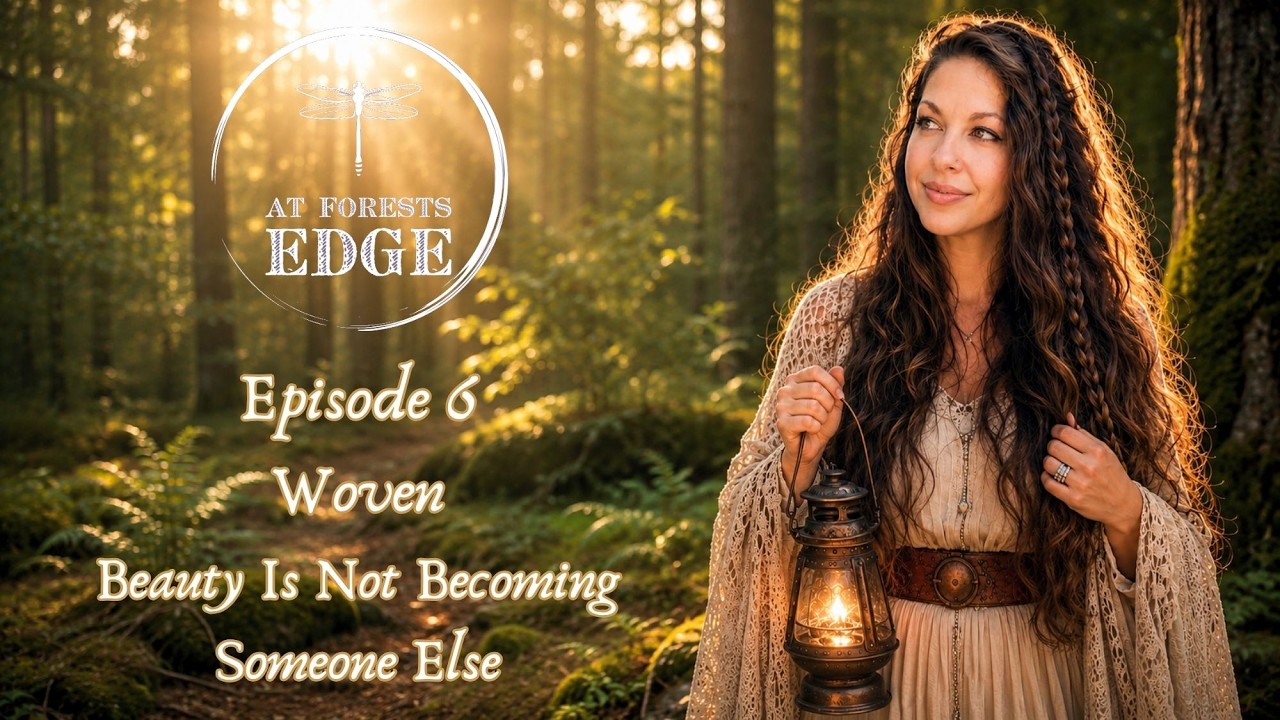
Woven: Beauty Is Not Becoming Someone Else
On beauty, belonging, and the voices that were never telling the truth
Dear friend,
I want to tell you something that took me most of my life to see.
For as long as I can remember, I believed my eyes were brown. That’s what I was told. That’s what the camera showed. Brown. Ordinary. Nothing particularly remarkable. And in a world that held blue eyes up as the standard of beauty, brown just felt like the lesser thing I happened to have been given.
Then one day, I actually looked. Not a glance in the mirror while brushing my teeth… a real looking. And what I found was not brown. Around the pupil, there’s this deep amber starburst, warm and ruddy, like something lit from within. From there, the color shifts into gold and green. And around the outer rim, there’s a deep, defined circle of dark green, like a border drawn around the whole of it.
I later discovered my father had the same eyes. My mother’s eyes are green, which I’ve always seen as the most beautiful color there is. In her defense, she always told me she loved my eyes, that she’d prayed for a brown eyed girl. But I’d been told my whole life by others that I had boring, ordinary eyes, when I’d been carrying something rare and layered and entirely my own the whole time. Nobody had looked closely enough to tell me what was actually there.
And I want to say something to the woman listening who does have brown eyes. Truly, purely, beautifully brown. Brown eyes are not boring. They never were. They’re warm and deep, and they catch the light in ways photographs never fully capture. Amber in the sun, dark as good coffee in the shade, the color of turned earth and autumn and everything rich and grounded and full.
The voices lied to us both. Mine, by telling me my eyes were something other than they were. Yours, by telling you that what you actually have is somehow insufficient. Neither of us was told the truth. Brown eyes are extraordinary. So is every other color God made. The lie was never about the color. The lie was always about the standard.
(And I will say one more thing while we’re here… I still claim “Brown Eyed Girl” as entirely my own. Van Morrison wrote it for me, clearly, because my grandfather used to sing it to me and dance with me, and I was the only brown eyed girl on that side of the family. My eyes may be amber and gold and green, but that song belongs to the little girl who danced with her grandfather, and no revelation about central heterochromia is ever taking that from me.)
The beauty standard is not a truth, it’s a market
This letter is longer than most, and I want you to know that upfront, because this topic deserves room. You’ve been carrying these voices for a long time. We’re not going to rush past them.
I want to name something plainly, because I think naming it clearly is the first step toward being free of it. The beauty standard is not a truth. It is a market. It has changed dramatically across every century, in every culture. Full figures were once the standard, then thinner, then muscular, then something else entirely. Pale skin was prized, then tanned, then pale again. Natural hair was celebrated, then straightened, then natural again. Every generation inherits a different standard and spends itself trying to reach it, only to find that by the time they arrive, it’s already moved.
This isn’t accidental. A standard that can be reached stops being profitable. A woman who feels genuinely beautiful as she is has very little reason to buy the next product, try the next procedure, chase the next version of herself the market decided is the goal this season. The beauty industry requires your dissatisfaction to survive. The moment you feel truly at home in the face and body God gave you, you become unprofitable to a system that was never designed with your flourishing in mind.
I grew up being told, as a woman of mixed heritage with light olive skin, that I looked pale and sickly, that I should be tanner, that my dark hair was mousy and blonde was beautiful, that my eyes were boring and blue eyes were much prettier, that my curves were too much. I never reached the size I was told to chase, and I was shamed for it, by people who should have known better and loved me differently.
I’m telling you this because I’ve stood where you’re standing. I’ve heard the voices. I believed them for longer than I should have. And I want to tell you what I found on the other side of finally, gradually, imperfectly, over many years… stopping.
The golden apple
I want to take you to ancient Greece for a moment, because there’s a myth at the root of our beauty culture that I think we need to name, examine, and set down.
The story begins at a wedding feast, to which all the gods were invited except one. Eris, the goddess of discord, was excluded, and in her anger she threw a golden apple into the feast, inscribed with three words: for the fairest. Three goddesses immediately claimed it. Hera, Athena, and Aphrodite. A mortal man named Paris was chosen to judge between them, to decide which was the most beautiful. Each goddess offered him a bribe. Aphrodite offered him the most beautiful woman in the world. He chose Aphrodite. He claimed Helen. And the result was the Trojan War… ten years of devastation, thousands of deaths, the destruction of an entire civilization. All of it begun by a golden apple, thrown by the goddess of discord, inscribed with the words for the fairest.
I want you to hear what that myth is actually saying beneath its surface. The beauty competition was started by the goddess of discord, on purpose. It was a weapon from the beginning. Designed to divide, to set women against each other, to ensure that the question of who is fairest would produce exactly the kind of destruction it produced. And we are still picking up that apple every time we look at another woman and measure ourselves against her. Every time we scroll past a face and feel the quiet diminishment of comparison, every time we compete instead of celebrate, we’re holding the apple Eris threw. And it was never meant for us. It was always meant to start a war.
God did not make women to compete with each other over a standard. He made us with different coloring, different features, different inheritances, not so one of us could win, but so all of us could contribute something the others cannot. The beauty He wove into each woman is not in competition with the beauty He wove into any other. It is additive. It is complementary. It is the inexhaustible creativity of a Maker who never runs out of original designs.
Put the apple down. It was never yours.
I am dark and beautiful
Now I want to take you to one of the most beautiful books in all of Scripture, the Song of Solomon, and specifically to the woman at the center of it, the Shulamite, who opens with one of the most quietly radical declarations in the entire Bible: “I am dark and beautiful, O daughters of Jerusalem… do not gaze at me because I am dark, because the sun has looked upon me.”
She’s been working in the vineyards. Her skin has darkened in the sun, and the women around her are looking at her with the particular gaze of people measuring someone against a standard and finding her lacking. You can feel it in her words, the awareness of being assessed, the expectation that she should apologize for her appearance.
And she does not apologize. She declares, “I am dark and beautiful.” Not dark, but beautiful. Not dark despite being beautiful. Dark and beautiful. Both true simultaneously. The very thing they were using to diminish her, she claimed as part of the whole of what she was, unashamed, undefended, simply stated.
I want you to hear that conjunction for what it is. It is not a concession. It is a correction. She is not agreeing that the darkness is a flaw and insisting she has beauty anyway. She is refusing the premise entirely. The thing you are looking at as a flaw is part of what I am. And what I am is beautiful. Both things. All of it. The whole of me.
That woman in the vineyard understood something that takes most of us decades to reach: that the standard the daughters of Jerusalem were holding is not the standard that matters, that the One whose gaze determines her worth sees her entirely differently. And she was not going to let their looking reshape what she knew about herself.
Say it for yourself, in whatever word fits. I am olive and beautiful. I am silver haired and beautiful. I am full figured and beautiful. I am the thing they told me was wrong, and I am beautiful. Both things. All of it.
How I stopped believing the voices
I want to tell you about the way I stopped believing the voices, because it was not a single moment. Not a morning I woke up transformed, or a conversation that changed everything in an instant. It was slower than that, quieter. The way fog lifts over a morning rather than the way a light switches on.
It happened in small accumulations. One day I noticed I’d stopped apologizing for my hair in conversation, stopped preempting comments about it, stopped explaining it, stopped treating it as something that needed defending. It was just my hair. It was just there, and I had simply stopped.
Another day, I caught my reflection somewhere unexpected, and the first thing I felt was not criticism, not the automatic inventory of what was wrong or what needed fixing… just, there she is. Something quieter and more neutral, and eventually something warmer than that. There she is. I know her.
The voices did not disappear all at once. They got quieter over time. They still visit occasionally, the old measurements, the old comparisons, trying to assert themselves in a weak moment. But they have less authority now, because somewhere in that long, gradual dawning, I began to trust a different voice. One that was there before the others. One that spoke over me before I had any opinion about myself at all.
My hair is not mousy. It never was. It has dimension no bottle of dye could recreate… bronze and golden and silver, whole ranges of color living together in the same strands, the kind of complexity that takes decades to develop. My grays are not something to hide. They are something that grew from a life fully lived. My skin is not sickly. It is olive, warm and Mediterranean, connected to ancestors I will never fully know, Slavic and Hispanic, traced back through threads I can only partly follow, whose features surface occasionally in the particular angle of something familiar in my face. Nobody quite places me, because I’m not one thing. I carry too many stories in my face for a single label to hold. And I’ve come to understand that this isn’t a confusion in my design. It is the point of it.
Your face is a map of where you came from
I want to sit with this for a moment, because I think it reframes something profound. Your features are not random. They are an inheritance. Every line and angle and coloring you carry is a continuation of someone who came before you, people who loved and grieved and hoped and survived and passed something of themselves forward without knowing exactly what form it would take when it arrived in you.
Your face is a map of where you came from. The nose that doesn’t fit neatly into any category. The eyes that carry a color combination that surprises people. The skin tone that shifts depending on the season and the light. These are not flaws in the genetic code. They are the record of a story longer than your own life, a story of migrations and marriages and generations of people whose lives threaded together in ways none of them planned, and produced something entirely new.
You were never supposed to look like everyone else. You are the particular, unrepeatable result of a specific thread of human history, meaning the creative intention of a God who does not mass produce. Your features are not a problem to be solved. They are a testimony to be read.
I have daughters who don’t share my coloring. One has auburn hair that shifts in the light, eyes that move between lavender and blue and green and teal depending on what she wears, fair freckled skin that’s warm and bright. Bold colors celebrate her rather than compete with her. Another has platinum hair so white it’s almost luminous, deep blue eyes, my complexion underneath, olive, with dark lashes and dark brows. I once saw someone online arguing that dark lashes and brows couldn’t belong on a real blonde, that it wasn’t natural, using an animated character as their example. And I thought of my daughter. My very own daughter has that exact coloring. It’s not a design choice. It’s just what some people actually look like.
But the standard is so rigid, the idea of what a certain look is “supposed” to be is so fixed in people’s minds, that a real, living variation reads as impossible to people who have stopped actually looking at human faces. We have all stopped actually looking at ourselves and at each other.
God does not repeat Himself. Every face is an original. Every coloring is its own palette. And the diversity across your own family, the different combinations of the same heritage expressing themselves differently in every child, is not inconsistency. It is the signature of a Maker who is inexhaustibly creative and who finds no face unremarkable, because He designed every single one on purpose.
Fearfully and wonderfully made
Psalm 139:14 says, “I praise you because I am fearfully and wonderfully made. Your works are wonderful, I know that full well.”
The Hebrew word translated “fearfully” is yare, and it doesn’t mean frightening. It means to be in awe of, to regard with reverence and wonder, the trembling recognition that you’re in the presence of something that exceeds ordinary measure. When Psalm 139 says you are fearfully made, it’s saying that the making of you produces this response in the One who made you. You are someone God regarded with wonder in the making. And the word “wonderfully,” pala in Hebrew, means to be distinguished, to be set apart, to be marked as extraordinary. Not ordinary. Not adequate. Extraordinary. There is nothing else exactly like it.
A few verses earlier, in verse thirteen, the word translated “knit together” is actually closer to woven. He wove you in the secret place. Woven implies pattern, intention, the active involvement of a Maker who chose every thread deliberately. Not assembled. Not produced on a line. Woven by hand, with wonder at what was being made.
The voices that told you your hair was mousy, your skin was wrong, your eyes were boring, your body was too much… those voices were never looking at you with wonder. They were measuring you against a standard you were never designed to fit. And they were wrong. Simply, completely, entirely wrong.
The silver haired head is a crown
Proverbs 16:31 says, “The silver haired head is a crown of glory, if it is found in the way of righteousness.” Women spend billions of dollars every year covering the very thing God called a crown. I’m not saying this to shame anyone. I colored my own hair when I was younger, chasing a version of myself I’d been told was more beautiful than what I was. But I want to name the inversion clearly. The culture says hide it, change it. Scripture says wear it.
My silver threads are not signs of aging out of beauty. They are the record of a life of hard seasons survived, and children raised, and prayers prayed in the dark, and mornings that came anyway. They’re woven into the bronze and the gold of what was already there, adding dimension no dye could fully replicate, and I would not trade them.
A word I want to offer with care
I want to say something carefully here, and with as much compassion as I can, because I know this is tender territory. I’m not standing outside of it looking in. I know women personally who are trying everything available to them to feel at home in their bodies, including medications that are producing real results, and I’m not here to take that away from anyone or to shame any choice a woman makes about her own body and health.
But I am watching, in my own journey and in the women around me, and what I’m seeing is that some of what’s being offered to women in the name of beauty and weight loss is extracting a price that isn’t always visible on the label. I say this not to frighten, but to invite a question. When we’re willing to risk our health for a number on a scale or a size on a label, is it worth asking whose standard we’re paying that price for, and whether that standard has ever truly had our flourishing in mind.
My own current journey is gentle. Walking, moving in ways that feel good rather than punishing, calming my nervous system rather than fighting my body. It’s slow, and it’s quiet. It doesn’t make for dramatic before and after content. But I’m learning to work with what God made rather than against it, and that feels, slowly, like coming home.
You do not have to punish your body into the standard. Your body is not your enemy. It is the house God gave you to live in. Tend it with kindness. Move it with joy. Feed it with real things, and extend to it the same grace you’re learning to extend to your face… the grace of looking closely and finding something worth honoring rather than something to be fixed.
Enhancement, not erasure
Before we land, I want to say something warm and clear, because I don’t want this letter to leave you feeling like every beauty ritual is suspect, or every act of adornment is a capitulation to the standard. It is not. There’s a difference between enhancement and erasure, and it matters.
Enhancement says, “I love what is here, and I want to celebrate it. I’m going to line these eyes that are amber and gold and green because they are extraordinary, and I want to honor that. I’m going to wear this color, this fabric, this particular combination of things that makes me feel like I stepped out of a Tolkien forest and into my actual life, because that is the most fully myself version of me, and I delight in it.”
Erasure says, “What is here is not enough and needs to be replaced. The goal is not to be more fully myself, but to be less myself, and more of whatever the current standard has decided is acceptable this season.”
Delight in yourself. Adorn what God made. Wear the eyeliner. Find the clothes that make you feel like a wood elf if that’s what makes you feel most alive. Express the specific, unrepeatable person you are, with joy and creativity and zero apology. Just do it from a place of celebration rather than correction. Do it because you love what’s there, not because you’re trying to replace it.
You were already the thing
Beauty is not becoming someone else. It is seeing clearly, really clearly, the way you look at something rare and lean closer, rather than glancing past what God already wove into you. The features that connect you to your ancestors. The coloring that carries more history than any single label can hold. The gray threads that are a crown. The eyes that were never the color you were told they were. The body that has carried you through every hard season and is still here, still yours, still woven by the same hands that made the rest of creation and stood back in wonder.
The Shulamite woman in the vineyard looked at the faces measuring her and said, “I am dark and beautiful.” Both things, all of it. The golden apple was thrown by the goddess of discord on purpose. The beauty competition was always a weapon. Put it down. You were never supposed to pick it up.
And the Voice that wove you, that chose every thread deliberately, that regarded what it was making with wonder, with the particular reverence due to something extraordinary… that Voice has never changed its assessment of you. Not once. Not when the voices told you otherwise. Not when you believed them. Not in the years it took you to slowly, gradually, imperfectly stop.
You do not have to change to be loved. You were loved in the making. You were wondered at in the weaving. You are fearfully and wonderfully made. And the standard that told you otherwise was never speaking the truth about you. It was only ever speaking the language of a market.
You are not a market. You are a masterpiece, and the Artist has never once looked at what He made and wished it were something else.
If you have a daughter who’s growing up in a world that’s already measuring her, or a friend who’s paying a steep price for a standard that keeps moving, or a woman in your life who’s never once been told to look closely at what is actually there… will you share this one with her? She may not know she needs it. Send it anyway. Tell her someone looked closely and found something extraordinary. Tell her the Artist stood back in wonder. Tell her she was always the thing.
Until next time, you were already the thing. You always were woven.
With love from the edge of the forest, Raeanna
If today’s letter stirred something in you, come find me at atforestsedge.com, where you’ll find my art, my book, The Happy Little Sunflower: Finding Hope in the Valley, my newsletter, and a way to reach me directly. I’d love to hear what’s on your heart.

Raeanna
Raeanna loves her home AT FORESTS EDGE. Cultivating life with a big family in America. She is a Watercolor Artist, Writer, Gardener & a Certified Herbalist.